top of page


The Museum
of Road Signs and Signals
and street lighting


Welcome to the world of MuSé miniatures.
The road signs we know today have been the subject of decades of research and innovation. Traffic lights, for example, have evolved significantly in line with available technologies, but also in the interests of road user safety.
MuSé's research is ongoing, and the discoveries made are fascinating and surprising.
Of course, none of this equipment exists anymore... MuSé presents a series of miniatures that faithfully reproduce the signs of yesteryear. This collection is unique and grows as historical research reveals new discoveries.

Westinghouse traffic light. Archives show this type of signal at Place Tivoli (Liège) in 1979, Place Saint Lambert in 1970, and also at the Bouxhe de Beaufays crossroads in the 1960s (they were later replaced by ATEA lanterns). It was also installed on the Wandre bridge, but disappeared in 1989 during the construction of the new cable-stayed bridge. This signal is made entirely of metal, including the contrast plate. The bulbs are filament bulbs with a power rating of 60 watts.
This miniature model is approximately 30 cm high and is fully functional. It dates from December 2019.


ATEA traffic light (Ateliers de Téléphonie et Electricité Anversoise, 1919-2003). These traffic lights literally flooded the Belgian road network from the 1970s onwards (the last replacements are planned for 2025). The miniature model on display at the MuSé is a reproduction of the signal located at the intersection of Rue des Grands Prés and Rue de la Station in Chênée (province of Liège). It consists of a three-colour lantern (also known as a ‘light box’), another two-colour lantern for pedestrians and a single ‘turn left’ signal. Like all signals of this era, they are equipped with 60-watt filament bulbs. The lanterns are made of metal, the sun visors are made of PVC (although the first ones were also made of metal) and the contrast plates are made of polyester.
This miniature model is approximately 30 cm high, is functional and dates from February 2020.


Nice set of signals: Westinghouse for the right-hand signal, dedicated to pedestrians; probably also for the left-hand traffic light (not certain). Common equipment on the streets of Liège in the 1950s and 1960s (sometimes until 1980). The filament bulbs for the three-colour signal were 60 watts, and 15 watts for the pedestrian signal. They were made entirely of metal. Although these signals have completely disappeared from our streets, we found some in Flanders in August 2024 that were still in perfect working order.
This miniature model, which is also functional, measures approximately 30 cm high and was manufactured in December 2019.

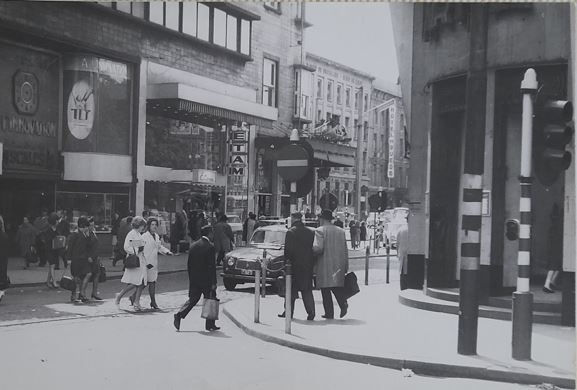

Surprising signals that were completely unknown to MuSé before the discovery of the photos (intersection of Rue de l'Université and Rue de la Régence; Blonden - Liège intersection). These signals are a mystery because we do not know who manufactured them. However, we do know that they date from 1960-1961. It is likely that the two-colour traffic lights for cars were equipped with 60-watt filament bulbs. We have no information about the pedestrian signal: 15 watts?
This miniature dates from July 2020 and measures approximately 25 cm in height.


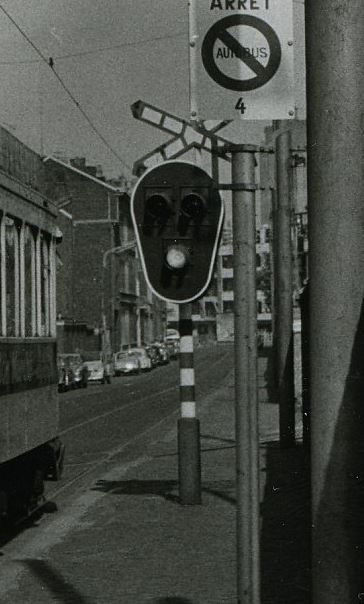
We are in Liège, on Rue d'Harschamp, in the heart of the city, and there is a level crossing guarded by this signal. The photo was taken in August 1964, and you will notice the old St. Andrew's cross on the post. We have no information about the manufacturer of this signal, but it is likely that the filament bulbs of the time had a power rating of 60 watts. The lower lamp, called the ‘moonlight’, was white; the two upper lamps were red and flashed alternately when a train approached the level crossing.
This model is approximately 30 cm high, is functional and was built in July 2020.

Two-colour signals were used on Belgian roads from the 1930s to the 1980s in Liège, gradually being replaced by three-colour signals (the 1961 Highway Code sets out the rules for two-colour and three-colour systems). There was a black and white signal, traces of which can be found in Seraing in 1956. It is likely that these signals were ATEA signals, with 60-watt filament bulbs. The mast was already red and white.
The MuSé miniature model is approximately 25 cm high, is functional and was built in 2019-2020.


In 1957, in Brussels, the three-colour system gradually began to appear on the road network. This massive three-colour signal, whose manufacturer is unknown, took its place alongside the two-colour system, which was destined to disappear. Note the consideration given to pedestrians with the appearance of two small signals halfway up the mast. It is likely that the filament bulbs used for this new signal were the same wattage as those used for the two-colour signals, i.e. 60 watts. For the pedestrian signal, the wattage was perhaps 15 watts. The contrast plate, certainly made of metal, was also a novelty at the time.
This miniature is approximately 30 cm high and was manufactured in 2022.


We are in the 1950s, on Rue de la Régence in Liège. Here we see a signal lit by a device placed above the post. It is likely that the light came from an incandescent bulb, the wattage of which we do not know (60 watts, as for two-colour and three-colour signals?). There were already backlit half-sphere signs in the streets of Liège.
This miniature measures approximately 25 cm high and was built in 2020.


Since the early 1970s, Belgium has acquired a large number of traffic lights, with tens of thousands of them lining our roads. Large-scale dismantling began around 2000. This traffic light was found in Ougrée, on a little-used road. These signs were manufactured by the Belgian company Callier in 1980, but we do not know the power of the fluorescent tubes they are equipped with. It is likely that the pole is older when we look at the base, the protected hatch and its general appearance.
This miniature is 40 cm high and was built in 2020.


The Belisha beacon, quintessentially British equipment. This signal was indeed present on our roads until the end of the 1970s. Found in Brussels, Anderlecht, Dison, Verviers, Waterloo, Liège, etc., it consisted of a flashing yellow-orange sphere designed to protect pedestrian crossings. The photo below was taken in Liège, Boulevard de la Sauvenière, in August 1964. The bulb used in this signal was a 60-watt filament bulb. The manufacturer offered a flashing system at the base and described it as very durable.
This miniature model is 30 cm high and was manufactured in 2020.


Road users probably don't remember these spherical light signals. Since the early 1970s, all kinds of light signals have appeared on our roads. The possibilities offered by polyester and fluorescent tubes have led to the emergence of signals in every shape and size imaginable. However, illuminated signs already existed before the Second World War (the photo dates from 1941). Our research shows us exclusively circular signs with a semi-spherical casing. The power supply must have been on the rear side (probably a filament lamp, power unknown). We also found them at Place Saint Lambert, Avenue Blonden, Rue Louis Fraigneux, among other places. The miniature model shown here has a red and white pole. We are not certain about these colours, as a photo shows us a blue and white pole for a signal (Place Saint Lambert). This miniature is approximately 25 cm high and was made in 2020.


Everyone thinks that modern dynamic traffic signals are the result of modern engineering. However, the idea of variable traffic signals already existed in Brussels in 1956. On this signal, there were three possible maximum speed limits indicated opposite the arrows. When the displayed speed was respected by the user, they were certain to have a green light at the next intersection. Otherwise, driving too fast would result in a red light at that same intersection. It is likely that this signal was equipped with filament lamps with a power rating of 60 watts.
The model is 30 cm high and was manufactured in 2021.


The E40 motorway, which runs from the North Sea via Brussels and Liège to Germany, connects at Battice to another motorway that goes to Verviers, among other places. This expressway, formerly known as the E5, was built in 1970 and was marked with large illuminated signs. These signs, which were used by the former police force and did not feature road numbers, were lit by fluorescent tubes.
The miniature model on offer here measures 48 cm in height and was built in 2022.


In 1933, tricolour signals appeared in some places on the Belgian road network, such as in Brussels, at the intersection of Rue Berckmans and Chaussée de Charleroi. With a black and white post and a two-colour lantern, it is very likely that this signal was equipped with 60-watt filament bulbs. Looking more closely at the lantern's body, we can deduce that these are ATEA (Antwerp) signals.
This model is 30 cm high and was manufactured in 2025.


Brussels, 1937: traffic was controlled by two-colour signals, probably operated manually. Outside the active phases of these signals, we believe that the yellow-orange sphere (Belisha beacon) must have flashed to attract the attention of road users at this intersection. The Belisha beacon was equipped with a 60-watt filament lamp. Based on our observations of the photo, the two two-colour signals were most likely made by ATEA.

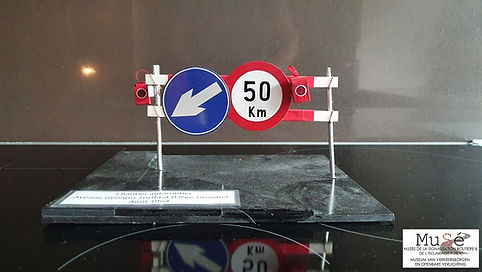
Droixhe district in Liège, 1964. At that time, public works policy was to bring motorways into cities. This was the aim of the works that currently provide access to the A25/E25 motorway towards the Dutch border. Part of this road network was transformed into an urban boulevard in 2024, rejecting the old idea of urban motorways.


After Belgium's regionalisation, Flanders decided to repaint its traffic lights. From 1990 onwards, traffic lights were no longer red and white, but black and yellow. The reason given was that these colours were more visible. As luck would have it, these two colours are precisely those of Flanders... While contrast plates were still in use at that time, often with ATEA (as in the photo) or Westinghouse equipment, modern LED signals do not have them. Swarco Futurit is very often used...
This model measures approximately 30 cm and was built in November 2025.


In 2013, the Brussels-Capital Region launched the idea of repainting its traffic lights. Gone were red and white, replaced by blue and yellow, the colours of the region. A test was planned at the intersection of Rue Belliard and Avenue des Arts. The plan was to repaint all the signals, i.e. 4,500 poles. The estimated cost was €1 million... In view of the potential bill, the Brussels-Capital Region abandoned the project.
This miniature signal is approximately 30 cm high, and the lantern reproduces an ATEA signal without a contrast plate. When contrast plates were fitted to the signals, our research shows that they were edged in yellow and not white as originally. Around 2017, these signals were replaced by Swarco Alustar equipment.


Let's visit eastern Belgium... And stop off at Verviers. Although this combined signal has been deployed throughout the country, we counted twenty signals of this type at locations near the station, hospital and courthouse. This is quite exceptional. This miniature reproduces a signal that controls both traditional traffic and bus traffic. Although this model is based on ATEA signals, in Verviers, Swarco Futurit lanterns equipped with halogen bulbs are used (on the station side, Sagem signals were located along the road).


At the Centre for Nuclear Energy Studies (CEN) in Dessel, there is an interesting light signal called ‘Koeltoren’. In English, this word means ‘cooling tower’. This combined signal was installed in 1979 and was still present on the site in January 2025, even though moss had grown on the equipment. It was manufactured by Socal-Light in Nijlen (province of Antwerp). We do not know whether it was still lit at night in January. The MuSé miniature model has been slightly redesigned: it is grey, the colour of light signals in East and West Flanders.


On the Condroz road (province of Liège), at the Plainevaux crossroads, there is a series of traffic lights to make this intersection between two national roads (N63 and N683) safer. This junction is dangerous and, to improve safety, the operator has equipped it with directional traffic lights fitted with 300 mm lenses (usually reserved for overhead consoles). All of this signage was replaced in September 2025 with modern LED equipment. This miniature reproduces one of these lanterns.


This light signal was probably discovered in the Seraing area in the 1950s. It was certainly equipped with a filament bulb (incandescent). Our research seems to indicate that the post was blue and white, colours that were also common at that time for directional signals. This directional signal no. 51 was either printed on sheet metal or made from enamel.


Welcome to Beauvechain, at the Hamme-Mille crossroads. It is located at the intersection of the N 25, N 91 and two municipal roads. Until the first quarter of 2025, it was controlled by traffic lights... Including this beautiful and unique five-lens model. It is an ATEA signal and it appears that the two arrows lit up simultaneously.

.jpg)
.jpg)
At first glance, this flashing orange signal seems ordinary. However, it has a special feature. The lens shows a pedestrian... This configuration has been used regularly in Liège in the past. This ATEA signal is representative of those installed to protect certain particularly vulnerable pedestrian crossings. Of the three locations we know of, two have been converted with Swarco Alustar signals specifically for pedestrians (signalling with two conventional lenses).


Discovered in Brussels, Rue de Namur in 1935 (our archives also show it on Place de la Bourse in 1930), this traffic light was probably operated manually by police officers. In the accompanying photo (Rue de Namur), we can see what was certainly a bell on the upper part of the signal. This bell system would also be used later on signals with two coloured lenses. While the mast of the signal shown here is plain coloured, those on Place de la Bourse in Brussels are marked with black and white stripes.


Hamme-Mille junction in Beauvechain... This set has not existed since the first quarter of 2025. It consists of ATEA traffic lights and illuminated signs (fluorescent tubes). Traffic signals could be integrated either into illuminated directional signs or into a street lighting pole. Note that the letter ‘u’ in Namur is inverted. This miniature set was produced in December 2025.


1969, Kennedy Tunnel in Antwerp. Roads and interchanges were equipped with brand new illuminated signage consisting of these units. Note the use of the Alfphabet font, which was used until 1972. These signs were illuminated with fluorescent tubes. This miniature sign was manufactured in December 2025.


This sign, mounted on a shortened pole, was installed in Belaar (Flemish region, Belgium). It is illuminated with fluorescent tubes and was manufactured by Socal-Light in 1976. The Socal factory (Société de construction aluminium) was located not far from Belaar, in Nijlen (Antwerp). This scale model was manufactured in December 2025.


This set was discovered in the Belgian Ardennes, in Pont de Villettes, not far from Bra. It consists of two ATEA flashing signals equipped with 300 mm lenses and 100-watt filament bulbs. The ‘STOP’ signal came from the Socal-Light factory and had the distinctive feature of being both luminous and reflective. This miniature set measures 40 cm high and was manufactured by MuSé in December 2025.


These signals were installed in Chênée, at the Pont de Chênée, in August 2015, replacing the existing ATEA system. The lanterns are Swarco Futurit LED models. It should be noted that these signals are powered by 220 volts, which does not correspond to the subsequent standardisation of a 42-volt power supply (Swarco Alustar standardised signals).


Completely disappeared from our roads, this sign, in this form, is described in Via Secura's ‘illustrated road safety code’ from May 1963. We owe this beautiful illustrative photo to Via Secura; we do not know the exact location of the sign. It is a Westinghouse lantern where we can see that the directional arrow is next to the green light; later, this arrow would be placed below, in line with the other lenses. The miniature model is 31 cm high.


This modern signal is located in Flanders, close to a military air base. In the past, it must have been equipped with a classic three-colour signal, as evidenced by the position of the mounting brackets on the pole. It is also shorter than classic signals, probably due to low-flying aircraft. It consists of only two black lines, compared to four for standard posts. It comprises a light signal equipped with fluorescent tubes (A35 panel) and a Swarco Futurit LED flashing light. This scale model was manufactured in December 2025.


In Olen, Flanders, to warn of a dangerous crossroads, the road authority installed this unusual flashing sign. It does not comply with the requirements for such a sign: the post is too short, the markings are unusual and there is no cap. When it was discovered, this ATEA lantern was not working (January 2025). This miniature sign was manufactured in December 2025.


Since the 1970s, major Belgian roads have been equipped with large illuminated signs. The one shown here (sign D1) had a diameter of 90 cm and was equipped with three 18-watt fluorescent tubes arranged in a triangle. In Wallonia, dismantling began in 2019-2020, depending on the condition of the sign: dilapidation, breakdown, reduced visibility, etc. They were replaced by conventional reflective signs. There were essentially two manufacturers: the Belgian company Socal-Light and the Luxembourgish company Solupla. Here are two illustrations from the E25 motorway: Beaufays and Vaux-Sur-Sûre. The miniature signal shown here is 29 cm high and was the first to join the collection in January 2026.


Between 1960 and 1970, the Beaubru crossroads in the province of Luxembourg was equipped with a complete set of illuminated traffic signs. Some of the advance warning signs were subsequently replaced. However, certain signs, such as this directional arrow, remained in place until spring 2026. It is equipped with two 20-watt fluorescent tubes (at the time of installation), later reduced to 18 watts. The arrow was modified in 1975.


Liège, Place Saint Lambert, the photo dates from 1960-61. It is unusual because it is combined with an orange light beacon. This signal operated on the classic two-colour traffic light programming: red and green. It was equipped with 60-watt filament bulbs, but we do not know what the illuminated bollard was equipped with (probably filament bulbs as well). This signal on the left was intended for tram traffic, as the word ‘tram’ is printed on both lenses.


This type of illuminated sign was widely installed on Belgian motorways in the early 1960s. This one comes from the E411 motorway, at the Habay interchange (no. 29). The sign is illuminated on both sides, which was occasionally seen on the network. However, the ‘E411’ sign is also illuminated on both sides, which is much rarer. The road authority donated some of this equipment in 2025, after it had been dismantled in 2023.


We may be looking at the ancestor of the repeater, a device that was not very common on Belgian roads in the 1970s and 1980s. This ATEA signal may seem ordinary, but it has reduced lenses. It was placed on a bridge in Chaudfontaine in the 1970s, just before the junction with the national road in the valley. As the bridge was too narrow, this signal was installed before the bridge crossing, perhaps to repeat the signal installed after the bridge, just at the junction.


Antwerp, 1969, the exact location is unknown. This three-colour signal features a ‘turn right’ lantern placed next to the classic green lens. This configuration was not unusual in the 1960s. What is surprising is the contrast plate specially designed for this configuration. Note the presence of the cast iron cap, which weighed 3.2 kilos!


In Charleroi and the surrounding area, several crossroads were equipped with this equipment in the past. The lanterns were manufactured by the French company Sagem. These signals must have been installed between 1990 and 2004. The two-tone design of the masts is striking and certainly specific to this region.

bottom of page